The Boring Problem That Could Break Biotech's Golden Age
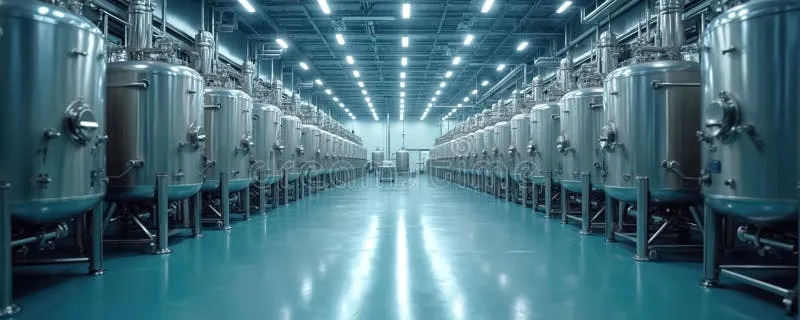
Photo: biotech laboratory manufacturing equipment industrial bioreactor facility, via thumbs.dreamstime.com
Nobody puts a bioreactor on the cover of a magazine. Nobody writes breathless profiles of the founders building better single-use filtration membranes or more reliable cold-chain logistics for temperature-sensitive biologics. The venture capital decks that get passed around Sand Hill Road are full of slides about gene therapies and AI-designed proteins and next-generation vaccines — not slides about who's going to manufacture the specialized growth media those therapies require at commercial scale.
That, it turns out, might be a serious problem.
American biotech is in a genuinely remarkable moment. The convergence of synthetic biology, machine learning, and decades of foundational research has produced a pipeline of potential therapies, materials, and food technologies that would have seemed fantastical twenty years ago. The science has never been more exciting. But underneath that excitement, a less glamorous crisis is quietly building — one that doesn't show up in press releases or funding announcements, but that researchers and manufacturing executives are increasingly alarmed about.
The supply chain that biotech runs on is buckling.
What Actually Goes Into Making a Biologic
To understand the problem, it helps to understand just how many specialized inputs go into producing a single biologic drug, engineered organism, or cell therapy at commercial scale.
You need the biological starting materials — cell lines, microbial strains, viral vectors. You need growth media formulated to precise specifications. You need bioreactors, often custom-built, to grow those cells in controlled conditions. You need chromatography resins to purify the resulting product. You need single-use plastic components — bags, tubing, connectors — that come in contact with the product and therefore require rigorous qualification. You need specialized analytical instruments to verify quality at each step. You need facilities built and operated to FDA Good Manufacturing Practice standards, which are exacting and expensive to maintain.
Every one of those inputs has its own supply chain. Many of them have only a handful of qualified suppliers worldwide. Some of the most critical components are manufactured in facilities that serve essentially the entire global biotech industry.
COVID-19 exposed how fragile that structure is. When demand for vaccine manufacturing inputs spiked suddenly and simultaneously across the entire industry, lead times for basic materials stretched from weeks to months. Single-use bioprocess components — bags and tubing that most people in the industry had never given a second thought — became nearly impossible to source. Companies that had been weeks away from clinical trial milestones found themselves stalled, not because the science failed, but because they couldn't get the equipment to run the experiments.
The Bottlenecks That Survived the Pandemic
Here's the uncomfortable reality: most of those vulnerabilities haven't been fixed. The pandemic created a brief window of awareness, some emergency investment in domestic manufacturing capacity, and a lot of task forces and working groups. What it didn't produce was a fundamental restructuring of the supply infrastructure that biotech depends on.
Several categories of constraint are particularly acute right now.
Specialized reagents — the biological and chemical inputs used in research and manufacturing processes — are still largely produced by a small number of suppliers, several of them European. When geopolitical disruptions, shipping delays, or a single facility fire interrupts supply, the downstream effects ripple across dozens of biotech companies simultaneously. There's limited redundancy in the system because building that redundancy is expensive and doesn't show up on any individual company's balance sheet as a competitive advantage.
Bioreactor capacity is another chokepoint. The large stainless-steel bioreactors used for high-volume biologics manufacturing take years to design, build, and qualify. The contract manufacturing organizations that run them — the CMOs that most biotech companies rely on rather than building their own facilities — are running at high utilization rates. Getting a slot in a qualified CMO facility has become a genuine strategic constraint for companies trying to move therapies from clinical trials to commercial production.
Then there's the workforce problem, which doesn't get nearly enough attention. Biomanufacturing requires a specific blend of skills — part biology, part chemical engineering, part quality systems — that takes years to develop. The US doesn't have enough of these workers, and the pipeline for training more is slow. Companies are competing for the same limited pool of experienced bioprocess engineers, and that competition is pushing salaries up while slowing the expansion of manufacturing capacity.
Who's Winning the Unglamorous Race
The companies that recognized this problem early — and built businesses around solving it rather than around the next scientific breakthrough — are quietly becoming very valuable.
A new generation of bioprocess technology startups is attracting serious investment by attacking specific bottlenecks. Some are developing better continuous manufacturing systems that can produce biologics more efficiently than traditional batch processes. Others are building modular, prefabricated biomanufacturing facilities that can be deployed faster and more cheaply than conventional construction. A few are applying machine learning to bioprocess optimization, squeezing more yield out of existing capacity.
On the reagents side, several companies are working on synthetic biology approaches to producing critical manufacturing inputs — essentially using engineered organisms to make the stuff that other engineered organisms need to grow. It's a recursive solution to a recursive problem, and it's attracting attention from investors who've noticed that the companies selling picks and shovels in a gold rush tend to do pretty well regardless of how many miners strike it rich.
Established players in the life sciences tools and equipment space have also woken up to the opportunity. Several major acquisitions over the past few years have been driven by larger companies trying to secure positions in the supply chain rather than chasing the next therapeutic breakthrough.
Why Washington Is Starting to Pay Attention
The national security dimensions of biotech supply chain fragility have started registering at the policy level. A significant portion of the specialized inputs used in US biomanufacturing — including certain fermentation equipment, filtration components, and raw materials — come from overseas suppliers, including some in geopolitically sensitive locations.
The CHIPS Act demonstrated that the federal government is willing to make large, targeted investments to shore up critical technology supply chains when the stakes are understood clearly enough. Several biotech industry groups have been making the case that biomanufacturing deserves similar treatment, with some success — recent federal spending packages have included funding for domestic biomanufacturing capacity, though most researchers say the amounts are still well short of what a genuine reshoring effort would require.
The Overlooked Opportunity
There's a counterintuitive investment thesis embedded in all of this, and the smarter money in biotech is starting to act on it. The next decade of biological breakthroughs is going to be constrained not by the quality of the science, but by the capacity of the infrastructure to translate that science into products that reach patients and markets at scale.
That means the companies building better bioreactors, more reliable reagent supply chains, faster facility deployment, and smarter bioprocess management systems are positioned to capture value from essentially every successful biotech program — regardless of which specific therapeutic area or technology platform ends up winning.
It's not a flashy pitch. You won't see it trending on tech Twitter. But in the next world of biotechnology, the companies that figured out the plumbing might end up being just as important as the ones who discovered the cure.