Two Hundred Feet Over Your Backyard, Someone Is Drawing Property Lines in the Sky
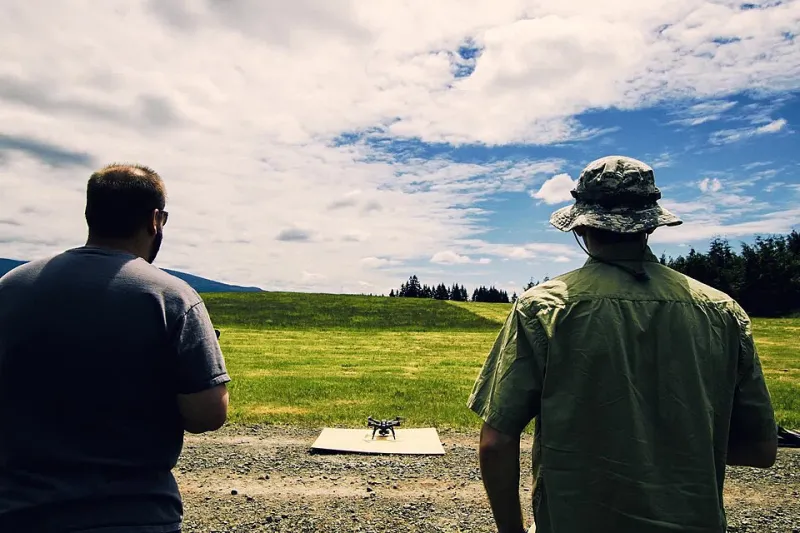
Photo: BLM Oregon & Washington, Public domain, via Wikimedia Commons
Here's a question most Americans have never had a reason to ask: who owns the air two hundred feet above your house?
The legal answer is a shrug. The practical answer, as of right now, is whoever shows up first with drones, and they are showing up fast. Walmart has promised drone delivery to the majority of the US population. Amazon's Prime Air keeps expanding past its College Station and Phoenix beachheads. Zipline, which cut its teeth delivering blood in Rwanda, is partnering with major healthcare systems to fly prescriptions to American porches.
This isn't a pilot program anymore. It's a land grab — except the land is air, and nobody's quite sure if anyone had the right to sell it.
The Vacuum That Wasn't an Accident
The FAA regulates the airspace, technically. But the rules governing beyond-visual-line-of-sight drone operations are a patchwork of waivers, exemptions, and pilot programs that were designed for a handful of experimenters, not a logistics network running thousands of daily flights over suburbs.
And here's the thing about regulatory vacuums: companies don't avoid them. They colonize them.
It's a playbook as old as American tech. Ride-sharing exploded before cities figured out whether it was legal. Cryptocurrency grew in the gaps between agencies arguing over who got to regulate it. In each case, by the time the rules arrived, the industry was too big, too popular with consumers, and too well-lobbied to stop. The regulation didn't shape the industry. The industry shaped the regulation.
Drone delivery is running the same play. Every new market Walmart enters is a fait accompli presented to local officials: the flights have started, the customers love it, and now what exactly would you like to do about it?
The Sound of Progress
Ask the people of the suburbs where this is already happening, and the answer is more complicated than the press releases suggest.
Noise complaints have piled up in places like the Dallas–Fort Worth area, where drone operations are densest. It turns out that a commercial drone isn't a graceful bird — it's a swarm of high-pitched blades, and a fleet making dozens of deliveries a day over your backyard is not the same as one making a charming demo flight. Researchers measuring drone noise found that people rate it as more annoying than road traffic at the same decibel level. The sound is intermittent, unpredictable, and directly overhead.
Then there's privacy. Today's delivery drones carry cameras for navigation. Tomorrow's will carry better ones. The airspace over your fenced backyard — the one your HOA defends so fiercely — is traversed daily by machines operated by some of the largest corporations in the country, and your property deed says nothing about it.
Why This Fight Actually Matters
It's tempting to shrug. It's just packages. But the airspace fight is really about the shape of the next logistics era, and logistics shapes everything else.
Whoever controls low-altitude flight networks controls the last mile — the most expensive segment of delivery, the one that determines whether a small pharmacy in Tulsa can compete with a national retailer's two-hour promise. A sky dominated by one or two logistics giants is a moat that no local business can cross. A genuinely open airspace, with neutral traffic-management systems and equal access, could be something closer to a public utility.
The difference between those two futures will be decided now, in waiver applications and city council meetings that almost nobody is paying attention to.
What a Fair Sky Would Look Like
The answer isn't to ban drones — the benefits are real, especially for rural America, where a drone can deliver medication in twelve minutes what takes an ambulance forty. The answer is to stop pretending the vacuum is neutral.
That means local noise ordinances with actual teeth. It means flight-path transparency, so residents can see who's flying over them and when. It means airspace traffic management treated as public infrastructure rather than a private service. And it means Congress finally passing a real drone framework instead of letting the FAA improvise with waivers.
The companies will tell you the sky is open and free. Legally, they're mostly right — and that's precisely the problem. The last great American land grab is happening where no deed can reach, and it's being won by whoever's already airborne.
Look up. The property lines are being drawn right now.